Mpg 341Cqpx Qd Oled Review: Real User Experience After 3 Months
When I first clicked "order" on the MSI MPG 341CQPX QD-OLED, I was coming from a standard 144Hz IPS panel that I had used for nearly four years. I had read all the marketing materials about the "infinite contrast" and "vibrant colors" of Quantum Dot OLED technology, but I was also deeply skeptical. As someone who spends eight hours a day coding and another three to four hours gaming or watching media, I was terrified of the two big OLED "boogeymen": permanent burn-in and blurry text rendering. After ninety days of lived-in experience, ranging from late-night Cyberpunk 2077 sessions to grueling spreadsheet marathons, I have a very clear picture of what this monitor actually offers beyond the spec sheet. This isn't a laboratory test; this is how the MPG 341CQPX changed my desk setup, for better and for worse.
The Initial Setup and First Impressions
Unboxing this beast was an event in itself. The first thing I noticed was just how incredibly thin the panel is at the edges. Since there is no traditional backlight, the screen feels like a sliver of glass. However, I was relieved to find that the central housing where the electronics and power supply live is sturdy and well-ventilated. I opted to use the included stand for the first month before VESA mounting it, and I found the stand to be surprisingly ergonomic, though it does take up a considerable amount of desk depth due to its wide footprint.
The first time I powered it on, I was immediately struck by the "inky blacks." It is a cliché in the monitor world, but seeing a completely black loading screen in a dark room where the monitor looks like it is actually turned off is a transformative experience. What I wasn't prepared for was the glossiness. The MPG 341CQPX features a semi-glossy finish that preserves the contrast beautifully, but I quickly realized I had to move a floor lamp that was sitting directly behind my chair because the reflections on the dark areas of the screen were distracting during the day.
Quality of Life: Text Clarity and Productivity
My biggest fear was text fringing. If you follow display tech, you know that early QD-OLED panels had a triangular subpixel layout that caused a weird "shadow" or "blur" around black text on white backgrounds. The MPG 341CQPX uses the latest Gen 2.5 or Gen 3 subpixel refinement, and I have to say, my fears were largely unfounded. In my experience, while it isn't as pin-sharp as a 4K IPS panel, it is a massive improvement over the first-generation OLEDs. I spent the first week obsessively looking for green or magenta shadows around letters in VS Code. After about ten days, I stopped looking because I simply didn't notice it anymore.
For productivity, the 3440 x 1440 resolution on a 34-inch ultrawide canvas is my "sweet spot." I found that I could comfortably snap two full-sized browser windows side-by-side. One thing that bothered me initially, however, was the aggressive "Static Screen Detection." When I would leave a static document open while reading on my phone, the monitor would dim itself quite significantly to protect the pixels. I eventually went into the MSI Intelligence menu and tweaked the sensitivity because it was a bit too eager to dim the screen during my actual work hours.
The 240Hz Gaming Experience
I didn't buy this monitor just for spreadsheets. I bought it for the 240Hz refresh rate. Moving from 144Hz to 240Hz is a noticeable jump, but the real magic here is the OLED response time. Because pixels can flip states almost instantaneously (0.03ms GtG), the motion clarity is staggering. In fast-paced shooters like Overwatch 2 or Apex Legends, there is absolutely zero ghosting. I noticed that my tracking aim improved slightly because the "blur" I was used to on my IPS panel was effectively gone.
Gaming in HDR is where the MPG 341CQPX truly earns its price tag. I've been playing through the Phantom Liberty expansion for Cyberpunk 2077, and the neon signs of Night City against the pitch-black shadows of the alleys are something no LCD can replicate. I found that using the "HDR Peak 1000" mode provided the most "wow" factor, though it does result in some visible brightness fluctuations (ABL) as the screen tries to manage power during very bright scenes. If you are sensitive to shifting brightness, the "True Black 400" mode is much more consistent, though less punchy.
Looking for the best Electronics deals on Amazon?
Shop Amazon →Working with MSI OLED Care 2.0
After three months, I've become very familiar with MSI's OLED Care suite. This is the software that tries to prevent your expensive investment from dying a premature death. Every four hours of cumulative use, the monitor wants to run a "Pixel Refresh." In the beginning, I found this annoying because a pop-up would appear in the middle of whatever I was doing. I learned that I could set it to run automatically when the monitor goes into standby, which was a huge "quality of life" fix. I also noticed features like "Boundary Detection" and "Taskbar Detection" that subtly dim the taskbar or the edges of windows. It’s a bit like having a tiny, invisible gardener constantly raking the pixels to keep them healthy. After 90 days, I have zero signs of image retention or burn-in, despite having the Windows taskbar visible for hours at a time (though I did eventually set it to auto-hide just to be safe).
Pros and Cons
- Unmatched Contrast: The ability to have a single bright white pixel next to a pure black pixel creates a level of depth that makes games look three-dimensional.
- Blistering Speed: 240Hz combined with OLED response times makes this one of the smoothest gaming experiences currently available on the market.
- Quantum Dot Color: The colors are incredibly saturated without feeling "fake." Red and greens, in particular, pop with a vibrancy that my old monitor couldn't even dream of.
- Firmware Updates: I was pleased to see that MSI allowed for easy firmware updates through the Gaming Intelligence app, fixing some early bugs with HDR EOTF tracking.
- Aggressive Dimming (Con): The safety features can sometimes be a bit too protective, dimming the screen during productivity tasks if you don't move windows around enough.
- Fringing in High Contrast (Con): While improved, if you look very closely (within 6 inches), you can still see some slight color fringing on fine lines or small text.
- Coating Maintenance (Con): The screen coating is a fingerprint magnet and can be tricky to clean. I found that I need a specific type of ultra-fine microfiber cloth to avoid leaving streaks.
- External Power Brick (Con): Some users might prefer an internal power supply, though I personally like that it keeps the heat away from the sensitive OLED panel.
Comparison with Competing Technologies
To give some perspective on where this monitor sits in the current landscape, I've put together a table based on my observations and comparisons with other panels I've used or tested recently.
| Feature | MPG 341CQPX (QD-OLED) | Standard IPS Ultrawide | Mini-LED (VA/IPS) |
|---|---|---|---|
| Contrast Ratio | Infinite (1,000,000:1+) | 1,000:1 (Average) | 50,000:1 (Variable) |
| Motion Clarity | Exceptional (0.03ms) | Good (1ms - 4ms) | Moderate (prone to smearing) |
| HDR Performance | Per-pixel dimming; no blooming | Poor (No local dimming) | High peak brightness; some blooming |
| Text Sharpness | Good (Gen 3 refined) | Excellent | Excellent |
| Burn-in Risk | Present (needs management) | None | None |
| Color Vibrancy | Very High (QD layer) | Standard | High |
A Buying Guide for Potential Owners
If you are considering the MSI MPG 341CQPX QD-OLED, don't just look at the 240Hz sticker. Think about your environment and your habits. Here is what I would tell a friend before they bought one:
First, evaluate your room lighting. In my experience, if you have a window directly behind you, the QD-OLED blacks can actually "lift" and look slightly greyish or purple due to the lack of a traditional polarizer in the panel. This monitor is at its absolute best in a "mood-lit" or dark room. If you work in a bright office with overhead fluorescent lights, you might actually prefer a high-end Mini-LED panel for the sheer brightness.
Second, honesty about your usage is key. If you are a professional who spends 10 hours a day exclusively in static Excel sheets and never plays games or watches movies, an OLED is probably the wrong choice. You are paying a premium for features you won't use while tempting fate with burn-in. However, if you are a "hybrid" user like me—someone who works by day and escapes into immersive worlds by night—then the trade-offs are absolutely worth it.
Third, check your GPU. Driving 3440 x 1440 at 240Hz requires a serious amount of horsepower. I'm running an RTX 4080, and even then, I rely on DLSS Frame Generation in newer titles to really take advantage of that high refresh rate. If you have an older card, you'll still love the colors and contrast, but you won't be seeing that 240Hz fluid motion very often in modern AAA games.
The Small Details: Ports and Build
I found the port selection on this monitor to be quite generous. It features a USB-C port with 98W Power Delivery, which is a lifesaver for me. I can plug my work laptop in with a single cable, and it charges while sending the video signal to the monitor. This cleared up a massive amount of cable clutter on my desk. I was surprised by how much I used the KVM feature as well; I have my keyboard and mouse plugged directly into the monitor, allowing me to switch between my desktop and laptop without having to swap cables.
Shop the latest Electronics picks on Amazon.
View Offers →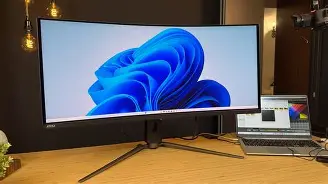
The build quality feels premium. There is a lot of high-quality plastic, but it doesn't creak or groan when you adjust the height. The joystick on the back for the OSD (On-Screen Display) is intuitive, though I highly recommend installing the MSI Gaming Intelligence app. It allows you to control all the monitor settings—including the OLED Care features—using your mouse instead of reaching around the back of the screen and fumbling with buttons.
Three Months Later: Is the Honeymoon Over?
Usually, after three months with a piece of hardware, the initial excitement fades and you just start to see the flaws. With the MPG 341CQPX, the "flaws" are mainly the inherent limitations of OLED tech, such as the brightness limiting and the need for pixel maintenance. What hasn't faded is the sheer joy of seeing my favorite games in a new light. I recently went back to play some older titles like Dead Space (the remake) and Alien: Isolation. The pure blacks of the space environments were so terrifyingly dark that it felt like a completely different game.
One thing that surprised me was how much I grew to appreciate the 1800R curve. At 34 inches, an ultrawide really needs a curve to keep the edges of the screen within your peripheral vision. The 1800R is subtle; it doesn't distort lines (important for my coding work), but it provides just enough "wrap" to feel immersive. I found that I had less neck fatigue compared to my previous flat 34-inch monitor because I wasn't constantly turning my head to see the corners.
Is it perfect? No. The glossy-ish screen means I have to be careful about what I wear while gaming (bright white t-shirts reflect surprisingly well in dark scenes), and the occasional pixel refresh interruption can be a minor nuisance. But these are small prices to pay for a display that looks this good. In my experience, moving from LCD to QD-OLED is equivalent to the jump from HDD to SSD—once you've lived with it, there is absolutely no going back.
Conclusion
After ninety days of daily use, the MSI MPG 341CQPX QD-OLED has firmly established itself as the centerpiece of my home office and gaming setup. What I found was a monitor that finally bridges the gap between professional-grade color accuracy and enthusiast-grade gaming performance. The 240Hz refresh rate combined with the incredible response times makes it one of the most capable gaming displays on the planet, while the improvements in subpixel layout make it a viable choice for those who also have to get work done. While the maintenance requirements of an OLED panel might be a deterrent for some, for me, the trade-off is clear. Every time I turn off the lights and fire up a game, the visual fidelity reminds me why I made the switch. It is a stunning piece of hardware that, despite a few quirks, represents the current pinnacle of ultrawide display technology.